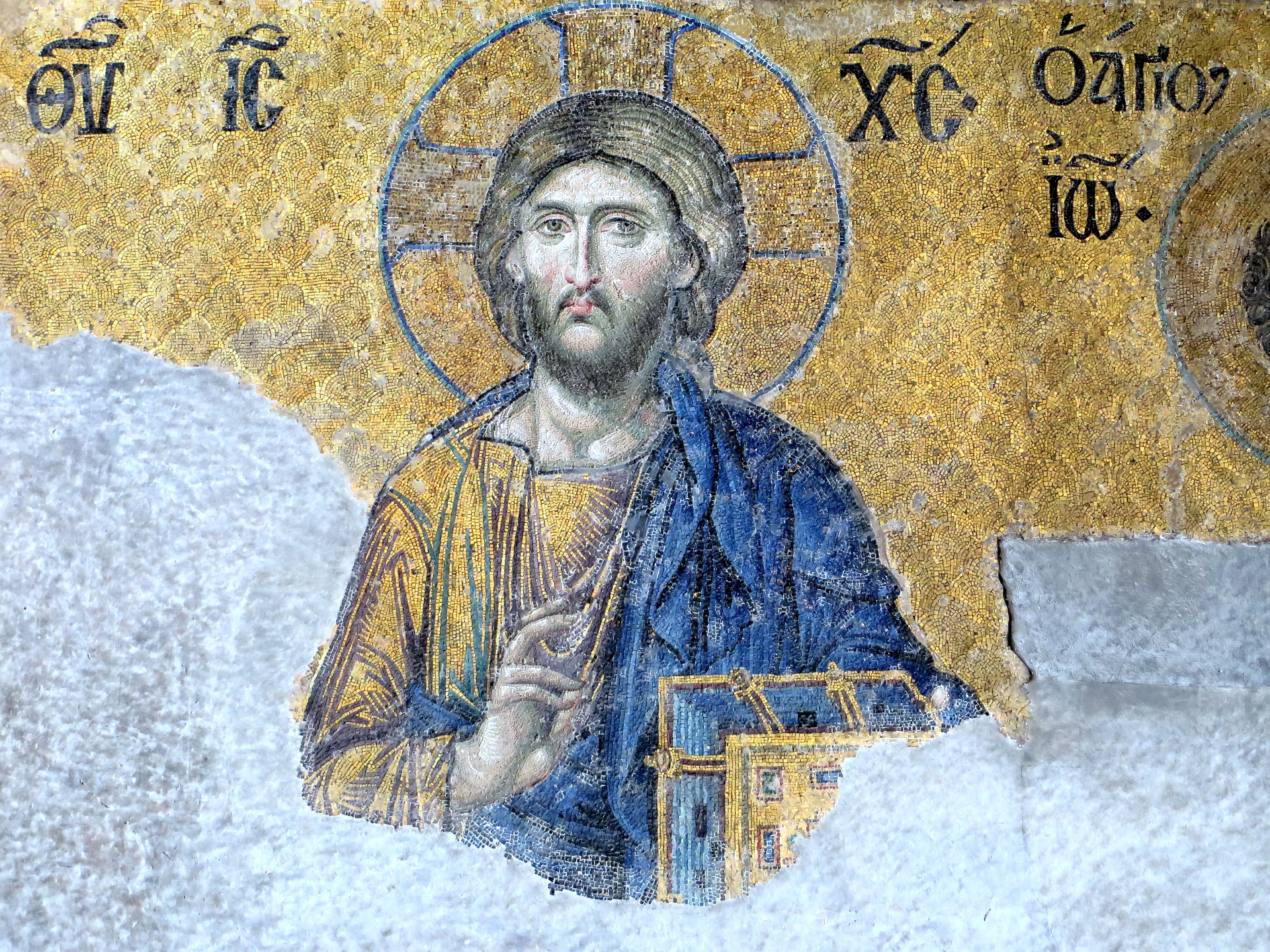
IN Huston Smith’s bestselling book The Worlds’ Religions, this authority on the history of religions observes that the historical life of Jesus was:
“…of a Jewish carpenter who, as has been often pointed out, was born in a stable, was executed as a criminal at age thirty-three, never travelled more than ninety miles from his birthplace, owned nothing, attended no college, marshalled no army, and instead of producing books did his only writing in the sand. Nevertheless, his birthday is kept across the world and his death day sets a gallows against almost every skyline.” (p.317/18)
And over two thousand years later, in the face of the rising tide of secularism, even the most cynical atheist might pause and wonder that when it comes to the brief life of Jesus Christ, we’re dealing with something out of the ordinary.
For those of us on the Vedantic path, we’re tantalized by the tell-tale signs that Jesus was a mystic of the highest order.
Formulator of the Yoga Sutras, Patanjali, would knowingly nod when Jesus informs us “if thine eye be single, thy whole body shall be full of light,” a deeply meditative state and experience confirming that “The Kingdom of Heaven is within.” And as Vedanta philosophy asserts that our real nature is divine, then our aim, as Jesus says, is to seek perfection: “Be ye perfect, even as the Father which is in Heaven is perfect.”
Inspired by these teachings and through concentrated prayer Christian mystics entered ‘yogic’ states. St.Symeon of Galatia saw:
“A huge light. It shone upon me, penetrating my mind and soul… I no longer felt any fear of death. My mind and soul were wholly absorbed in the ineffable joy of that light.” Isaac the Syrian described how “A moment comes when you cross the boundary from these active forms of prayer and meditation, into the realm of pure meditation. At that moment all mental activity of every kind ceases.”
With many of the teachings of Jesus echoing the central ones of Vedanta, it gives credence to the claims of scholars that Hindu religious ideas were prevalent throughout the Roman Empire for centuries before Jesus Christ – carried by travellers from India: Brahminic teachers, merchants and immigrants.
Scholars also claim that John the Baptist, forerunner to and baptizer of Jesus, was an Essene, a Buddhist sect prevalent in Palestine which introduced foreign ideas of asceticism and mystical union with God.
Whatever our view of Jesus, whether we’re secular or spiritual, Christian or not, Christmas can be a magical time of year. A time to relax and reflect, to gather with family and friends, to erect colourful Christmas tree ‘shrines’ and to be more sharing, kinder and joyful, far more than just gift giving and feasting.
As they say: ‘It’s not what’s under the Christmas tree that matter it’s who’s around it.’
We celebrate Christmas Eve in Vedanta Hall on Thursday 24 December. See ‘Coming Up’ section.