 IN 1852 a teenager left his village in the peaceful, timeless, countryside of West Bengal, accompanying his elder brother on a journey to the crowded atmosphere of Kolkata. A few days later, when they made their weary way into the city – no one noticed.
Today, with the benefit of hindsight, we can link the arrival of these two village Brahmin brothers to a series of extraordinary events that have influenced the history of India.
In 1852 Kolkata was the capitol of India, second in importance only to London in the mighty British Empire. Through a blending of European and Indian Cultures and the questioning spirit of the modern mind this was a time of great creativity and transformation in that city. Great reformers, educationists, poets, writers and spiritual giants arose in India and in Kolkata in particular.
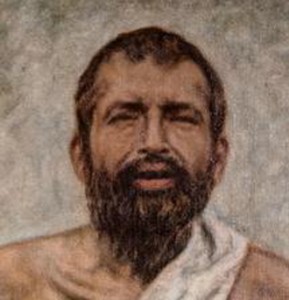
In a gleaming new temple at the northern end of the city, some years after his arrival there, the village Brahmin teenager, known as Sri Ramakrishna, had become a priest. Having explored the varying spiritual paths of Hinduism and having experienced the best of Islam and Christianity as well, the word went out amongst the intelligentsia of Kolkata that a very unusual Holy Man was in their midst. Having immersed himself in intense meditation and other spiritual practices Sri Ramakrishna lived in that rare world of the mystics, a borderland between normal and super-consciousness.
To Sri Ramakrishna’s room at Dakshineswar came creative, brilliant, questioning minds, minds that were a jumbled mix of Eastern and Western ideas. To name just a few, Mahendranath Gupta, noted educationist and recorder of the Gospel of Sri Ramakrishna, Dr.Mahendralal Sarkar, founder of the Indian Association of Science, Girish Ghosh the famed dramatist and a student called Narendranath Dutta, the future Swami Vivekananda. To their astonishment they saw in Sri Ramakrishna a type of spirituality and mystical states they had only heard about, or read about in books. He also had a special ability to convey deep spiritual truths through homely illustrations.
Through them Sri Ramakrishna came face to face with the modern mind, with its doubts, its restlessness, its arrogance and its crying need for proof that God is real and can be experienced. In Sri Ramakrishna they found living, walking, talking proof that God does exist, and can be experienced here and now, and that there is no greater joy than this. Any
Painting by Ulla Mattas doubts they had about the reality of spiritual life and experiences began to fade away. In Sri Ramakrishna’s presence they realized that sages still walked on this earth.
The life and teachings of Sri Ramakrishna and his famous disciple Swami Vivekananda have inspired many leaders of modern India, significantly influencing the emergence of a more self-confident nation on its way to becoming a world superpower.
Sri Ramakrishna declared, from his experience of Hinduism, Christianity and Islam, that all faiths lead to God and it is only sincerity in religious life that is needed to reach God, a relevant message for the modern world.
Suggested Reading (See Books Section for further information):
- Gospel of Sri Ramakrishna by Mahendranath Gupta
- Ramakrishna and His Disciples by Christopher Isherwood
- Ramakrishna and His Divine Play by Swami Chetananda
- Great Thinkers on Sri Ramakrishna & Swami Vivekananda
Great Thinkers on Ramakrishna
ARNOLD TOYNBEE -English Economic Historian.
‘In the Hindu view, each of the higher religions is a true vision and a right way, and all of them alike are indispensable to mankind, because each gives a different route to the same goal of human endeavours. Each, therefore, has a special spiritual value of its own which is not to be found in any of the others.
‘To know this is good, but it is not enough. Religion is not just a matter of study; it is something that has to be experienced and to be lived, and this is the field in which Sri Ramakrishna manifested his uniqueness. He practised successively almost every form of Indian religion and philosophy, and he went on to practise Islam and Christianity as well. His religious activity and experience were, in fact, comprehensive……’
DALAI LAMA – Former Head of the Tibetan Govt. in Exile & Nobel Peace Prize Winner
‘Sri Ramakrishna was one of the greatest of India’s spiritual adepts of recent times, actively embodying India’s profound tradition of plurality. By assimilating the sadhanas, customs, and practices of different faiths into his own personal practice, he presented a powerful example of respect for other traditions even while maintaining a deep fidelity to his own. His transparently pure and well-documented life remains a guide and inspiration to millions on their spiritual path.’
JAWAHARLAL NEHRU – First Prime Minister of Independent India
‘Sri Ramakrishna Paramahamsa obviously was completely outside the run of average humanity. He appears to be in the tradition of the great rishis if India, who have come from time to time to draw our attention to the higher things of life and of the spirit….
‘Men often scoffed from a distance at this man of no learning, and yet when they came to him, very soon they bowed their heads before this man of God and ceased to scoff and “remained to pray.”
PHILLIP GLASS – Composer
‘It would be hard to overestimate the impact that the life, presence and teaching of Sri Ramakrishna had on the formation of the modern India we know today. It was as if the sleeping giant of Indian culture and spirituality – certainly one of the foremost cultures of the ancient world – had been re-awakened and empowered to take its rightful place in modern times.
 The Power behind the Ramakrishna Movement.
COMMONLY known as ‘Holy Mother’ she was the quiet power supporting her husband, Sri Ramakrishna, as he shared his spiritual joy and wisdom with those who flocked to his room at the Dakshineswar Temple in Kolkata. By the time of his passing this bashful, village girl had also matured into a wise, spiritual power.
Behind her veiled orthodox background, she learned all that had to be learnt about humanity, mind, God and the universe. She emerged as a leader for the eclectic group of intellectuals, academics, social reformers, religious aspirants and others from all over North India who had sat at the feet of Sri Ramakrishna.
The youngest men in this group vowed to become monks and establish a monastic order. Over the years as the new Movement developed the monks revered her as both a spiritual mentor and a problem solver for numerous organizational, social and theological challenges.
She’s forever revered as a sweet but firm guiding force behind the challenging formative years of the Ramakrishna Movement.
Suggested Reading (See Books Section for further information):
The Power behind the Ramakrishna Movement.
COMMONLY known as ‘Holy Mother’ she was the quiet power supporting her husband, Sri Ramakrishna, as he shared his spiritual joy and wisdom with those who flocked to his room at the Dakshineswar Temple in Kolkata. By the time of his passing this bashful, village girl had also matured into a wise, spiritual power.
Behind her veiled orthodox background, she learned all that had to be learnt about humanity, mind, God and the universe. She emerged as a leader for the eclectic group of intellectuals, academics, social reformers, religious aspirants and others from all over North India who had sat at the feet of Sri Ramakrishna.
The youngest men in this group vowed to become monks and establish a monastic order. Over the years as the new Movement developed the monks revered her as both a spiritual mentor and a problem solver for numerous organizational, social and theological challenges.
She’s forever revered as a sweet but firm guiding force behind the challenging formative years of the Ramakrishna Movement.
Suggested Reading (See Books Section for further information):
- Holy Mother by Swami Nikhilananda
- Holy Mother the Great Wonder
- Teachings of Holy Mother Sri Sarada Devi
- Eternal Mother
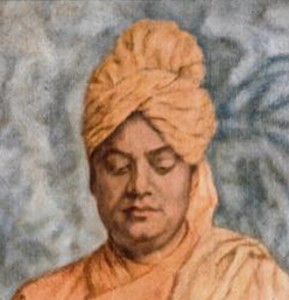 IT WAS IN THE AFTERNOON of September 11, 1893, in America. In Chicago’s Great Hall of Columbus; a young man from India stood before an audience of 7,000 people, among them, writers, poets, philosophers, bishops, priests, theologians and other leaders of Society. He shared the stage with learned world leaders of various faiths. An air of expectant silence pervaded the Hall as the young man, overawed by the magnitude of the moment, uttered a silent prayer to Sarasvati, the Goddess of Wisdom, imploring her to speak through him. Then, with his “tongue nearly dried up,” he launched himself into an inspired speech lasting just a few minutes. He sat down almost exhausted and was amazed to hear and see the impact this speech had made on the audience. Thunderous applause filled the Hall.
The event was the first day of the Parliament of Religions, held in connection with the World’s Columbian Exposition in the City of Chicago from September 11 to 27, 1893. The Exposition had been organized to celebrate the four hundredth anniversary of the discovery of America by Christopher Columbus. The young man was Swami Vivekananda. In his speech he shared with the audience the age old, universal teachings so prevalent in Hinduism. He quoted a prayer recited by Hindus each day,
“As the different streams, having their sources in different places, all mingle their water in the sea; O Lord, so the different paths which men take through different tendencies, various though they appear, crooked or straight, all lead to Thee.”1
Why did the audience respond so enthusiastically to the Swami’s speech? Swami Nikhilananda answers this question in his book, Vivekananda a Biography:
1) Swami Vivekananda in the West, New Discoveries Vol 1, by Marie Louise Burke, Advaita Ashrama, p.84.
Painting by Ulla Mattas
“.. the whole audience had been patiently awaiting this message of religious harmony. A Jewish intellectual remarked to the present writer, years later, that after hearing Vivekananda he realized for the first time that his own religion, Judaism, was true, and that the Swami had addressed his words on behalf of not only his religion, but all religions of the world. Whereas every one of the other delegates had spoken for his own ideal or his own sect, the Swami had spoken about God, who, as the ultimate goal of all faiths, is their inmost essence. …. The Swami gave utterance to the yearning of the modern world to break down the barriers of caste, colour, and creed and to fuse all people into one-humanity.”
Narendranath Datta, as he was originally known, grew up in that fascinating time when Kolkata, being the capitol of India and the second most important city in the British Empire was the chief port of entry for European ideas and cultural influences. Indicative of the interesting exchange of ideas and cultural influences of those times in Kolkata, it was through Prof.William Hastie, an Englishman and one of his teachers at college, that Naren came to know about Sri Ramakrishna. Prophetically, Sri Ramakrishna saw that this young man had tremendous potential and gave special guidance to him. Some years later, after taking monastic vows and taking the name, Swami Vivekananda, he emerged as one of the greatest reformers of Hinduism and a leading representative of India and Eastern philosophy throughout America, England and Europe. Since 1985, in recognition of the tremendous contribution the Swami has made to the nation, India has celebrated Swami Vivekananda’s birthday as national youth day.
Suggested further reading (See Books Section for further information):
- Vivekananda a Biography – Swami Nikhilananda
- The Life of Vivekananda and the Universal Gospel – Romain Rolland
- Vedanta Voice of Freedom – Swami Chetananda Ed.
- Selections from the Complete Works of Swami Vivekananda
- Individual books: Raja Yoga, Jnana Yoga, Karma Yoga, Bhakti Yoga
Great Thinkers on Swami Vivekananda
CHRISTOPER ISHERWOOD – Anglo-American Novelist & Playwright
‘Here, at last, was a man who believed in God and yet dared to condemn the indecent grovellings of the sin-obsessed Puritans I had so much despised in my youth. I loved him at once, for his bracing self-reliance, his humour, and his courage. He appealed to me as the perfect anti-Puritan hero: the enemy of Sunday religion, the destroyer of Sunday gloom, the shocker of prudes, the breaker of traditions, the outrage of conventions, the comedian who taught the deepest truths in idiotic jokes and frightful puns.’
HENRY MILLER – American Writer & Painter
‘The story of the pilgrimage of this man who electrified the American people reads like a legend. At first unrecognized, rejected, reduced to starvation and forced to beg in the streets, he was finally hailed as the greatest spiritual leader of our time.
‘He made India known to America; he had spread the light. And in doing so he had opened the eyes of his countrymen to their own weaknesses.
2) Vivekananda a Biography, Swami Nikhilananda, Advaita Ashrama, p.134.
‘I am coming back to him later, to his clean, powerful words, spoken like a fearless champion not of India but of the human race.’
INDIRA GANDHI – First Woman Prime Minister of India
‘Swamiji preached the message of universal brotherhood. And a single word which echoed and reached all in his speeches was abhih – fearlessness.
MAHATMA GANDHI – Internationally Renowned Indian Nationalist and World Thinker
‘I have gone through his works very thoroughly, and after having gone through them, the love that I had for my country became a thousand fold.’
U THANT – Former Secretary-General of the United Nations
‘Swami Vivekananda was the greatest spiritual ambassador of India, if I may say, in the history of India, and for that matter, the history of Asia. The main purpose of his visit to the United States … was to find a synthesis….. he wanted to find a harmony, a kind of synthesis between the Eastern concept of culture and civilization and the Western concept of culture and civilization…’