NOW AND AGAIN, we hear of a child prodigy displaying stupendous abilities at a ridiculously young age.
Word spreads about them quickly. They often find themselves surrounded by those who want to make use of their superhuman abilities, to make them a celebrity, placing them under tremendous pressure, robbing them of a normal childhood.
This month we celebrate the birthday of an ancient child prodigy whom none could manipulate.
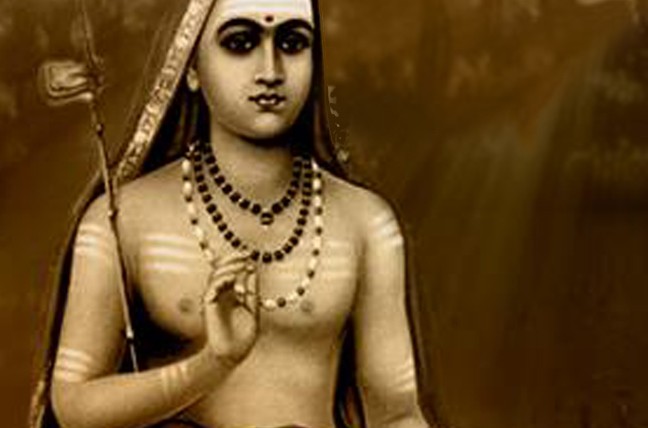
By the age of 10, Sankaracharya, the 8th Century Indian philosopher, had read, memorised and written commentaries on all the primary scriptures of the time. Rather than avoid the gaze of the public, he thrust himself into the role of a reformer and debater.
It makes you wonder, what was it like to meet and hear Shankaracharya, mesmerising all with his brilliance, charming all to see such wisdom radiating from his glowing, youthful face?
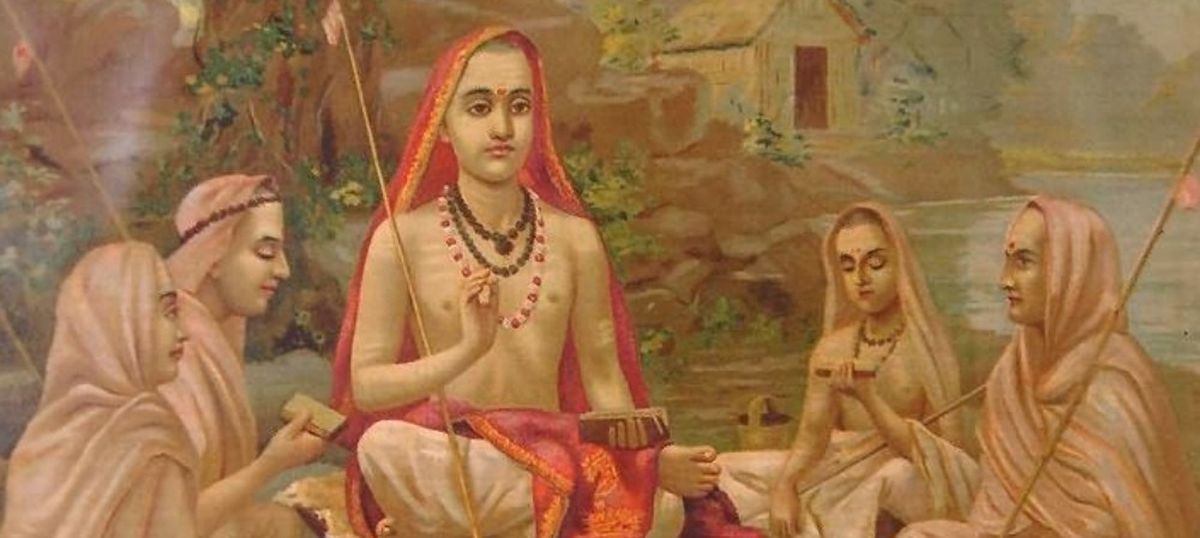
Calmly and methodically, Shankaracharya created a spiritual and philosophical revolution, visiting Centres of learning and point by point exposing the inconsistencies in the teachings of many spiritual leaders.
You can imagine the drama of seeing this mere teenager confidently striding into the presence – often uninvited – of some great teacher and his followers and boldly challenging him to a debate, bringing with him a youthful sense of humour.
Such was the case when he arrived – unannounced – to challenge the anti-monastic dualistic philosopher Mandana Mishra who greeted him with the angry interrogation: “Whence have you come, you shaven-headed fellow?” Meaning, by what way he came in when the gates were closed. Full of mischief, Shankara deliberately mistook the question to mean ‘How far are you shaven?’ and replied, “Up to the neck.” “That is not what I asked,” said Mandana, “I asked about your way.” To this, Sankara quipped, “Did you ask the ‘way’? Then what did the ‘way’ reply?” Annoyed terribly, Mandana retorted, “It replied that your mother is a widow and that you are a widow’s son.”Unconcerned, Sankara humorously remarked: “Indeed: Did the ‘way’ tell you that ‘you’ are a widow’s son? Then it must surely be so. For, it was you and not me who questioned the ‘way’, and in the answer you received, the ‘you’ must surely refer to yourself.”
Apart from this cheeky humour, Sankaracharya conducted himself in such a noble way that many teachers, rather than taking offence, were inspired enough to become his disciples.
Like all great reformers, he was fearless in his teachings, refusing to pander to the likes and dislikes of Society, providing the highest and most confronting Vedantic teachings through classics such as Bhaja Govindam (Verses 6 – 9):
· Remember, riches bring in grief: Truly, no joy abides in them. A rich man even fears his son: This is the position everywhere.
· Lost in play is the carefree stripling, Lost in his sweetheart’s charms, the youth; The old man broods upon his sorrows; None there is, alas, whose spirit yearns to be lost in the Parabrahman.
· Who is your wife? And who your child? Strange indeed is this mortal world! Who are you? And who is your own? Where is the region whence you come? Brother, ponder on these things.
· Good association breeds detachment; Detachment leads to freedom from delusion; Undeluded, one contacts changeless Reality; Contact with Reality bestows liberation while alive.
While this philosophical revolution was unfolding in India, it’s interesting to note what was happening in Europe at that time. The great Emperor, Charlemagne, before whom even the Pope would bow, was consolidating his empire. His Christian soldiers were busily converting or subduing the Pagans and heathen Saxons in ways that Jesus Christ would surely never have approved. Meanwhile, a new religion called Islam spread rapidly and began to pose a threat to the Christians.
Sankaracharya is mainly known for his advocacy of non-dualistic philosophy, the study of which can often lead to a rather cool and dry outlook on life. But he had a deeply devotional side, too, overflowing in poetic masterpieces extolling Shiva, Vishnu and the Divine Mother. Being a true knower of self, Shankara knew that philosophy and devotion were simply two sides of the same coin.
Like all inspired geniuses, he had boundless energy. In his short life of 32 years, he travelled the length and breadth of India no less than three times.
He brought about lasting changes in society. One example being the four influential monasteries he established: one each in the North, East, South and West of India. These monasteries, 12 centuries later, are still functioning and are highly respected.
We celebrate the birthday of Sankaracharya on Sunday 16 May.
To know more, we recommend the book Sankara Digvijaya available from the Vedanta Book Agency.